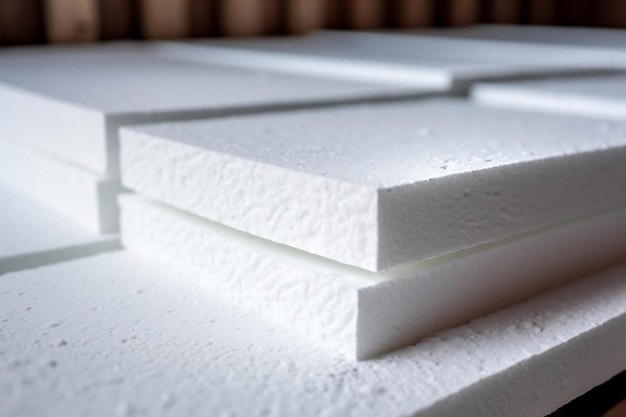
The Insulating Concrete Formwork (ICF) system is a new method of constructing concrete walls that uses polystyrene formwork to create high-strength structures. These formworks are easy to install and remain a permanent part of the structure after the concrete is poured into them. This technology makes the walls not only very strong structurally, but also act as effective insulators against heat, sound and moisture.
Steps to implement the ICF system:
Installing the formwork: First, polystyrene foam formwork is easily and quickly installed on site. These formwork require little time to install and the preparation of the concrete pouring site is done quickly.
Placing the reinforcements: At this stage, the designed reinforcements are placed inside the formwork. This system uses multi-purpose spacers to ensure the accuracy of placing the reinforcements in the right place.
Pouring the concrete: After installing the formwork and placing the reinforcements, the space inside the formwork is filled with self-compacting concrete. After curing, this concrete hardens completely inside the formwork and creates resistant and reinforced walls.
Maintaining the formwork: After the concrete cures, the polystyrene formwork remains in place and there is no need to remove them. These forms remain permanently as insulation and an integral part of the walls of the structure.
Advantages of the ICF system:
Energy savings: One of the outstanding features of this system is the reduction of energy consumption in buildings by up to 70%. Due to the insulation of polystyrene, the walls of the building do not lose heat and prevent excessive cold from entering.
Reduction of project implementation time: The ICF system allows a 40 to 50 percent reduction in the time required for stiffening. The rapid installation of forms, placement of reinforcement, and pouring of concrete accelerates the construction process.
Savings in the use of rebar: Due to the optimal design and high resistance of the system, the consumption of rebar in this system is reduced by about 25 to 30 percent.
High speed of construction: Due to the easy and quick installation of forms and effective concreting, this system is especially suitable for large and mass construction projects. A building of up to 145 square meters can be completely built in a short time.
Resistance to lateral forces: Due to the combination of concrete and polystyrene foam, walls built with this system have excellent resistance to lateral forces such as wind and earthquakes and are very suitable for areas with high earthquake risk.
Proper concrete curing: Polystyrene forms help concrete to cure in optimal conditions. This coating maintains the appropriate temperature and humidity for concrete to harden.
No need to remove forms: Since the forms remain permanently, there is no need to use release agents to remove the forms after concrete is poured.
Applications:
The ICF system is used to build load-bearing and non-load-bearing walls, beams, doorways, foundations, and retaining walls. This system is widely used in the construction of residential, commercial, and industrial buildings, especially in mass construction projects and buildings resistant to earthquakes and harsh environmental conditions.